Worlds of a Distant Sun: 47 Ursae Majoris b
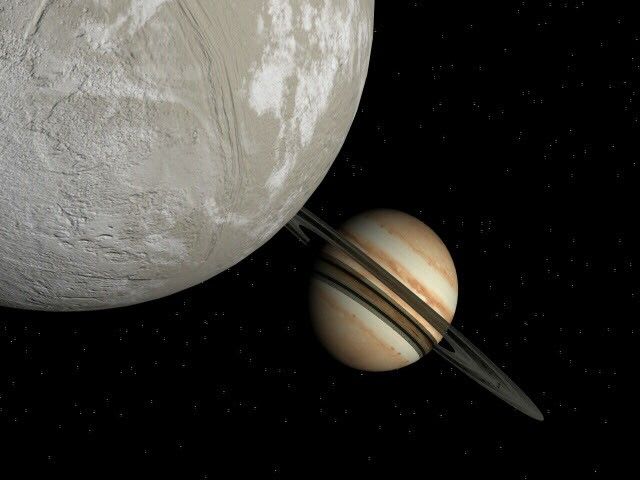
Within the last few years, observational astronomy has given humanity evidence of the existence of worlds beyond the solar system. Indeed, solar-type stars are now inferred to harbor planets of approximately Jupiter mass - some residing in temperature zones which could conceivably support liquid water and therefore life ! Above is a hypothetical scene near one such planet whose sun, 47 Ursae Majoris (47 UMa), is a yellow dwarf star (spectral class G0 V) very similar to our own. In our sky, it appears as a faint, inconspicuous star below the cup of the northern hemisphere asterism, “the Big Dipper” . (Our own sun would be equally inconspicuous when viewed from 47 UMa ...) Astronomer's G. Marcy and P. Butler announced the discovery of a planet associated with this star in 1996 and reported it to have a mass of about 2.4 Jupiters or more with an orbital period of 3 years. This artist's vision pictures the detected planet, referred to as 47 UMa b, as a gas giant surrounded by a ring of material - analogous to our own gas giant Saturn . In the foreground lies a hypothetical moon of 47 UMa b. Could such a moon support life? 47 UMa is only 44 light years distant, fairly close by astronomical standards - yet there is evidence for planetary systems which are closer still. NASA plans to explore nearby planetary systems using spaceborne observatories. APOD News: RJN to MTU