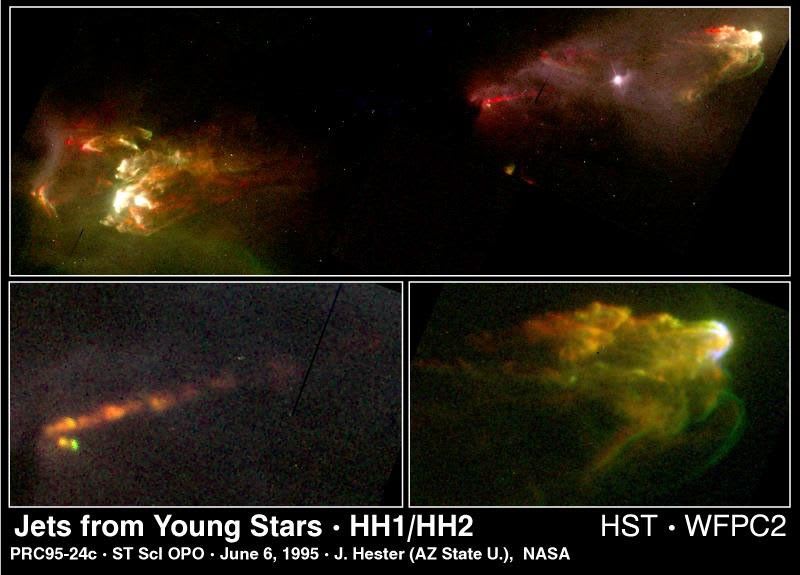
HH1/HH2: Star Jets
A cloud of interstellar gas and dust collapses and a star is born . At its core temperatures rise, a nuclear furnace ignites , and a rotating dusty disk forms surrounding the newborn star. According to current understanding , as material continues to fall onto the disk it is heated and blasted back out along the disk's axis of rotation, forming a pair of high speed jets. This Hubble Space Telescope image shows two nebulosities at the ends of opposing jets from a young star. The bright blobs at either end are where the jet material has slammed into interstellar gas. Tip to tip, the distance is about one light-year. Located near the Orion Nebula , these nebulosities have catalog designations HH1 and HH2 for their discoverers astronomers George Herbig and Guillermo Haro. The nascent star which produced the jets is in the middle, hidden by a cloud of obscuring dust. Yet the structures and details visible in the star jets offer clues to events which also occured in our own Solar System - when the Sun was formed from a collapsing interstellar cloud 4.5 billion years ago.