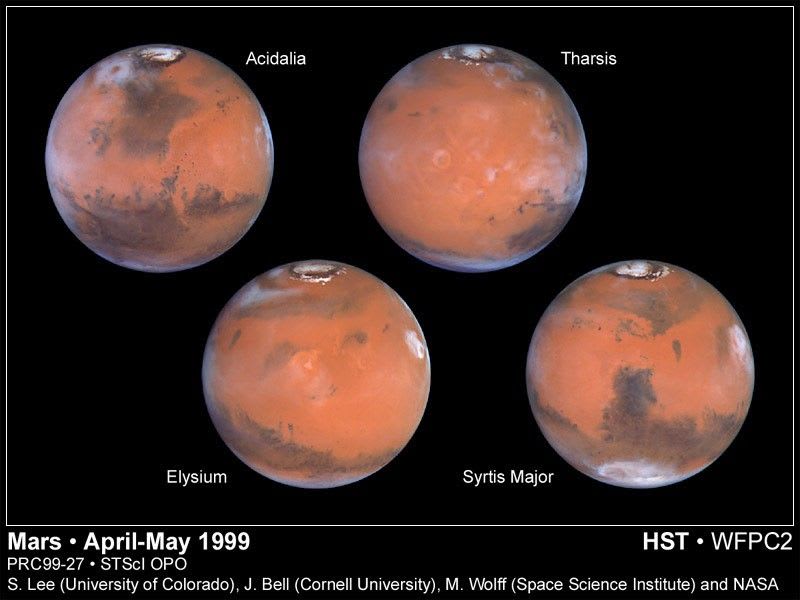
Four Faces of Mars
As Mars rotates, most of its surface becomes visible. During Earth 's recent pass between Mars and the Sun , the Hubble Space Telescope was able to capture the most detailed time-lapse pictures ever from the Earth . Dark and light sand and gravel create an unusual blotted appearance for the red planet . Winds cause sand-tinted features on the Martian surface to shift over time. Visible in the above pictures are the north polar cap , made of water ice and dry ice , clouds including an unusual cyclone , and huge volcanoes leftover from ancient times. The Mars Global Surveyor satellite orbiting Mars continues to scan the surface for good places to land future robot explorers .