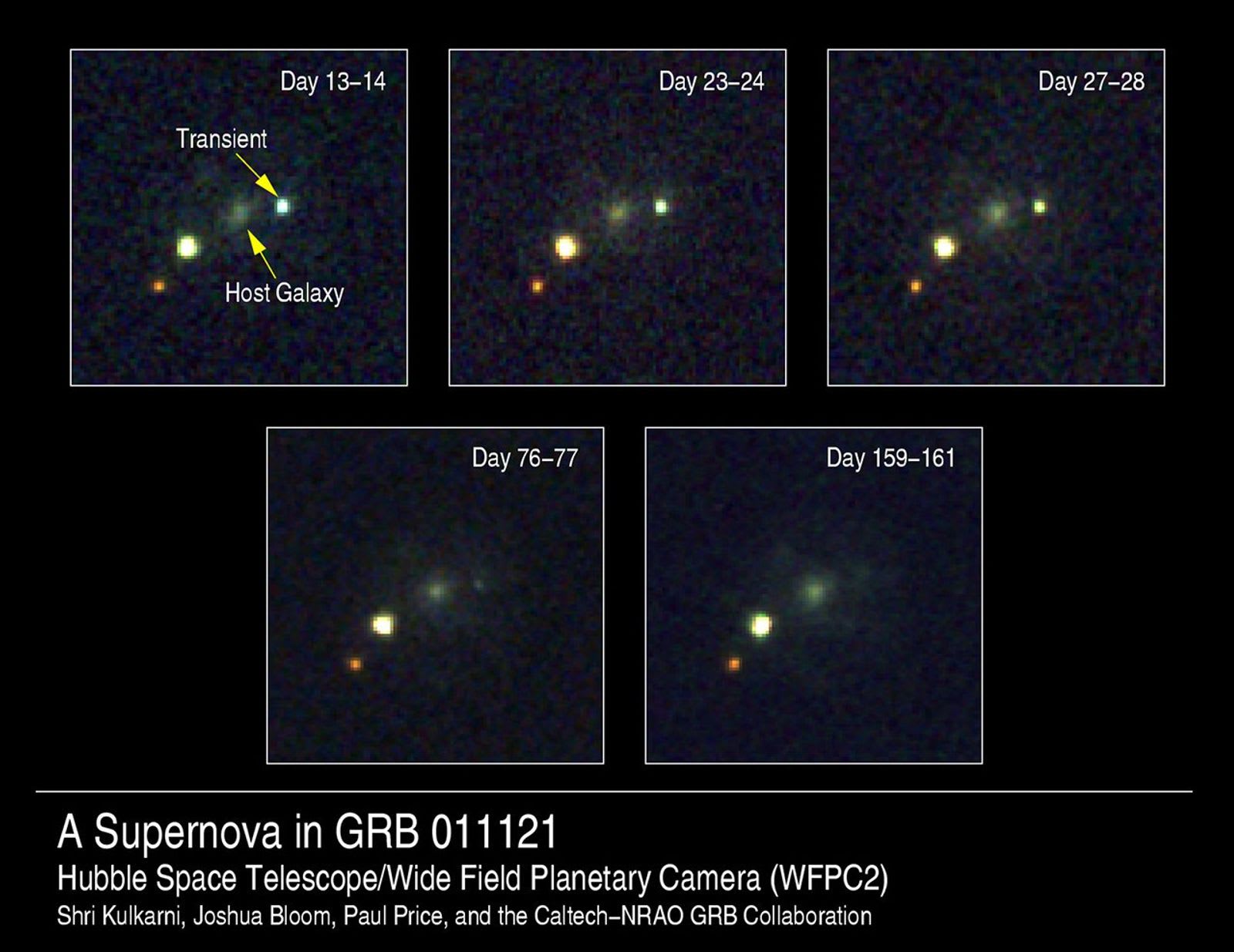
Gamma-Ray Burst, Supernova Bump
On the 21st of November 2001, satellites detected yet another burst of gamma-rays from the cosmos. While this flash of high-energy photons lasted for less than a minute, eager astronomers have been following the fading optical light from the location of the burst source ever since. Seen above in a series of Hubble Space Telescope images recorded from December 4, 2001 to May 5, 2002 (13 through 161 days after the burst), the fading transient lies to the right of a fuzzy, distant galaxy, likely home to the gamma-ray burster. Two constant point-like objects to the left of the galaxy are foreground stars within our own Milky Way . The transient did not not simply fade away, though. Observations from the Hubble , OGLE , and the large Magellan telescope in Chile indicate that it bumped up or brightened again days after the burst in a convincing display characteristic of a supernova - the death explosion of a massive star. These results add to the mounting evidence that at least some of the mysterious cosmic gamma-ray bursts are produced in the violent event which ends the lives of massive stars.