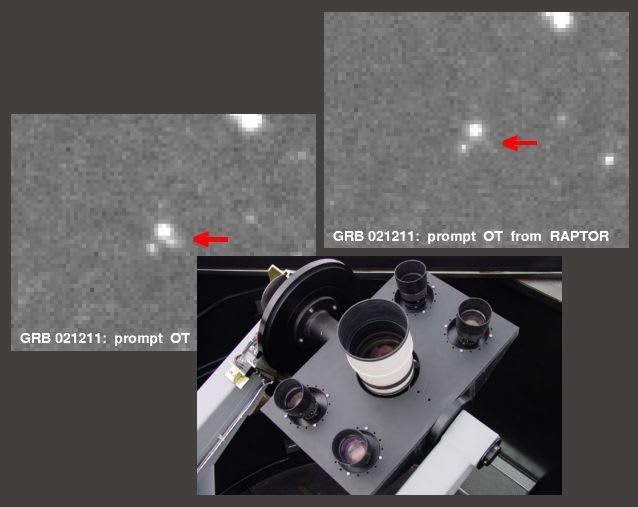
RAPTOR Images GRB 021211
On December 11 astronomers found one of the brightest and most distant explosions in the Universe - a gamma-ray burst - hiding in the glare of a relatively nearby star. The earliest image of the burst's visible light was caught by an earthbound RAPTOR (RAPid Telescopes for Optical Response). The two exposures inset above were taken by a RAPTOR unit about 65 seconds (left) and 9 minutes (top right) after high-energy radiation from the burst, dutifully cataloged as GRB 021211 , was identified by the orbiting HETE-2 satellite . One of only two optical transients (OTs) ever found at times so close to a burst's gamma-ray emission , the fading visible light source is indicated by arrows, blended with the image of foreground stars toward the constellation Canis Minor . The RAPTOR unit (lower inset) is designed with peripheral low resolution cameras and a central, sensitive high resolution imager, in analogy with a predator's vision . In the future, the RAPTOR project expects its innovative instruments to be able to independently discover and catalog a host of cosmic things that go bump in the night .