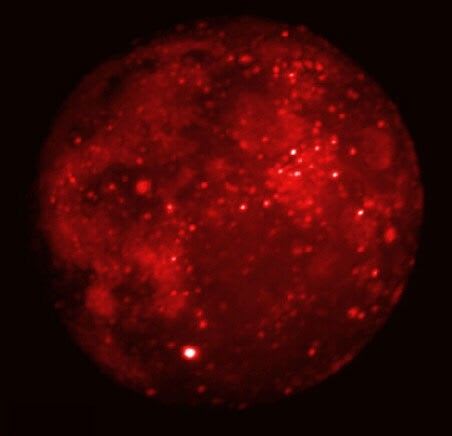
Eclipsed Moon in Infrared
In September of 1996, the Midcourse Space Experiment (MSX) satellite had a spectacular view of a total lunar eclipse from Earth orbit . SPIRIT III, an on board infrared telescope, was used to repeatedly image the moon during the eclipse . Above is one of the images taken during the 70 minute totality, the Moon completely immersed in the Earth's shadow . Infrared light has wavelengths longer than visible light - humans can not see it but feel it as heat . So, the bright spots correspond to the warm areas on the lunar surface , and dark areas are cooler. The brightest spot below and left of center is the crater Tycho , while the dark region at the upper right is the Mare Crisium . Of course, this Sunday's lunar eclipse will not be a total, or even a partial one. Instead , the Moon will glide through the subtle outer portion of the Earth's shadow in a penumbral eclipse of the Moon .