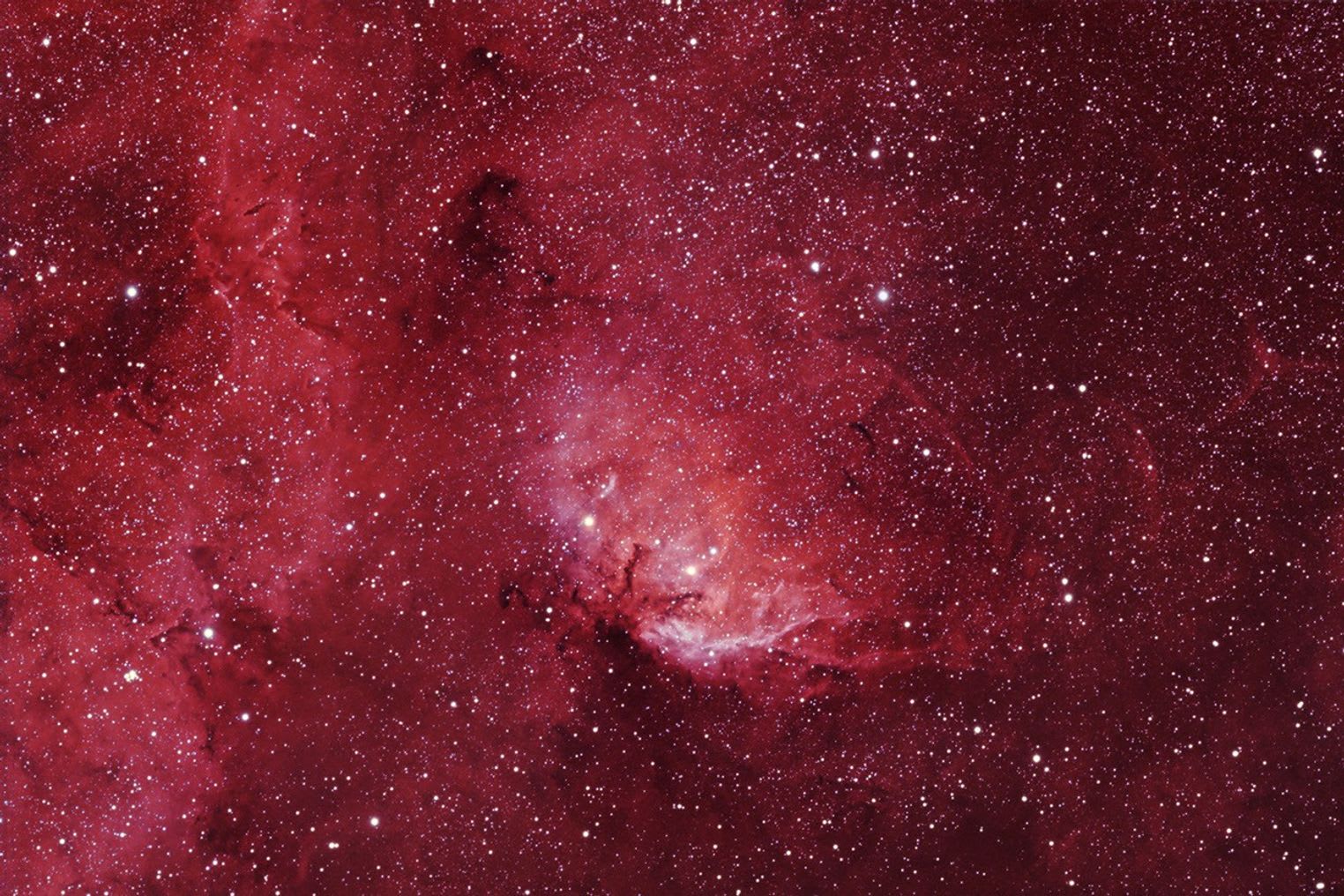
The Tulip in the Swan
This expansive (1-degree wide) telescopic view looks out along the plane of our Milky Way Galaxy toward the nebula rich constellation Cygnus the Swan . It is centered on a bright hydrogen emission region recorded in the 1959 catalog by astronomer Stewart Sharpless as Sh2-101 . About 8,000 light-years distant the nebula is popularly known as the Tulip Nebula, understandably not the only cosmic cloud to evoke the imagery of flowers . Complex and beautiful in visible light, the area also includes one of the brightest, most famous sources in the x-ray sky , Cygnus X-1. Discovered in the early 1970s, Cygnus X-1 is a bizarre binary system consisting of a massive, hot, supergiant star ( seen here ) in close orbit with a stellar mass black hole . The Cygnus X-1 system is also estimated to lie a comfortable 8,000 light-years away.