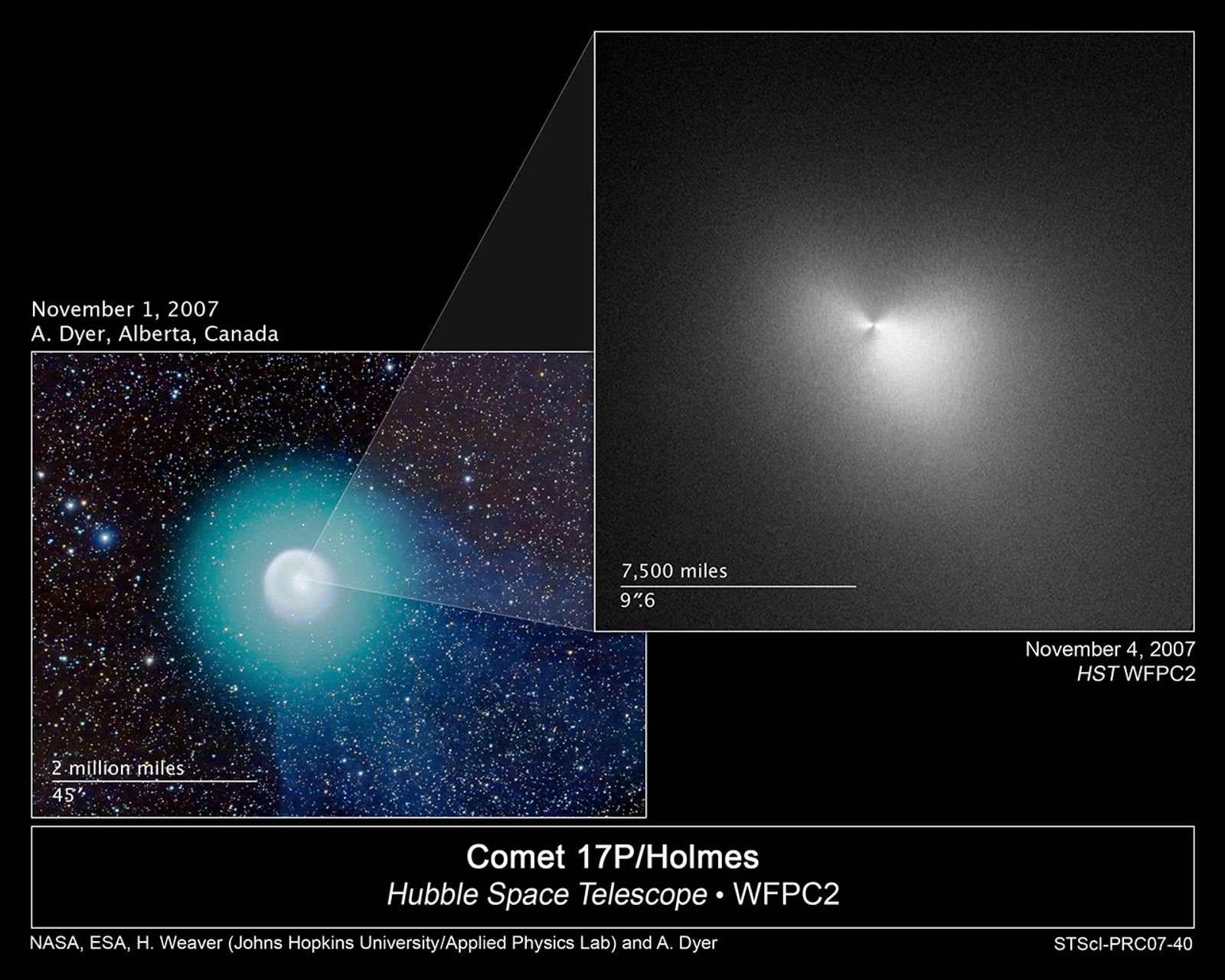
Comet Holmes from the Hubble Space Telescope
Why did Comet Holmes brighten? The unexpectedly bright Comet 17P/Holmes continues to grace northern skies as a naked-eye addition to the constellation Perseus. Any northern sky enthusiast with a dark sky , a bright curiosity , and a recent sky map should still be able to locate the comet in a few minutes. What is seen, however, is primarily the sun-light reflecting dust coma . It surrounds an iceberg nucleus too small and too faint to discern. Clues to the nearly million-fold brightness increase are therefore being sought in dramatic images of the enigmatic comet's central regions taken earlier this month by the Hubble Space Telescope . One such Hubble image, shown above , indicates a still unresolved dense central dust cloud near the nucleus , surrounded by a more complex, anisotropic coma. The Hubble images do not show any obvious fragmentation of the nucleus, however, as was seen last year in Comet Schwassman-Wachmann 3 . Observers around and above the world will continue to study this unusual addition to the night sky .