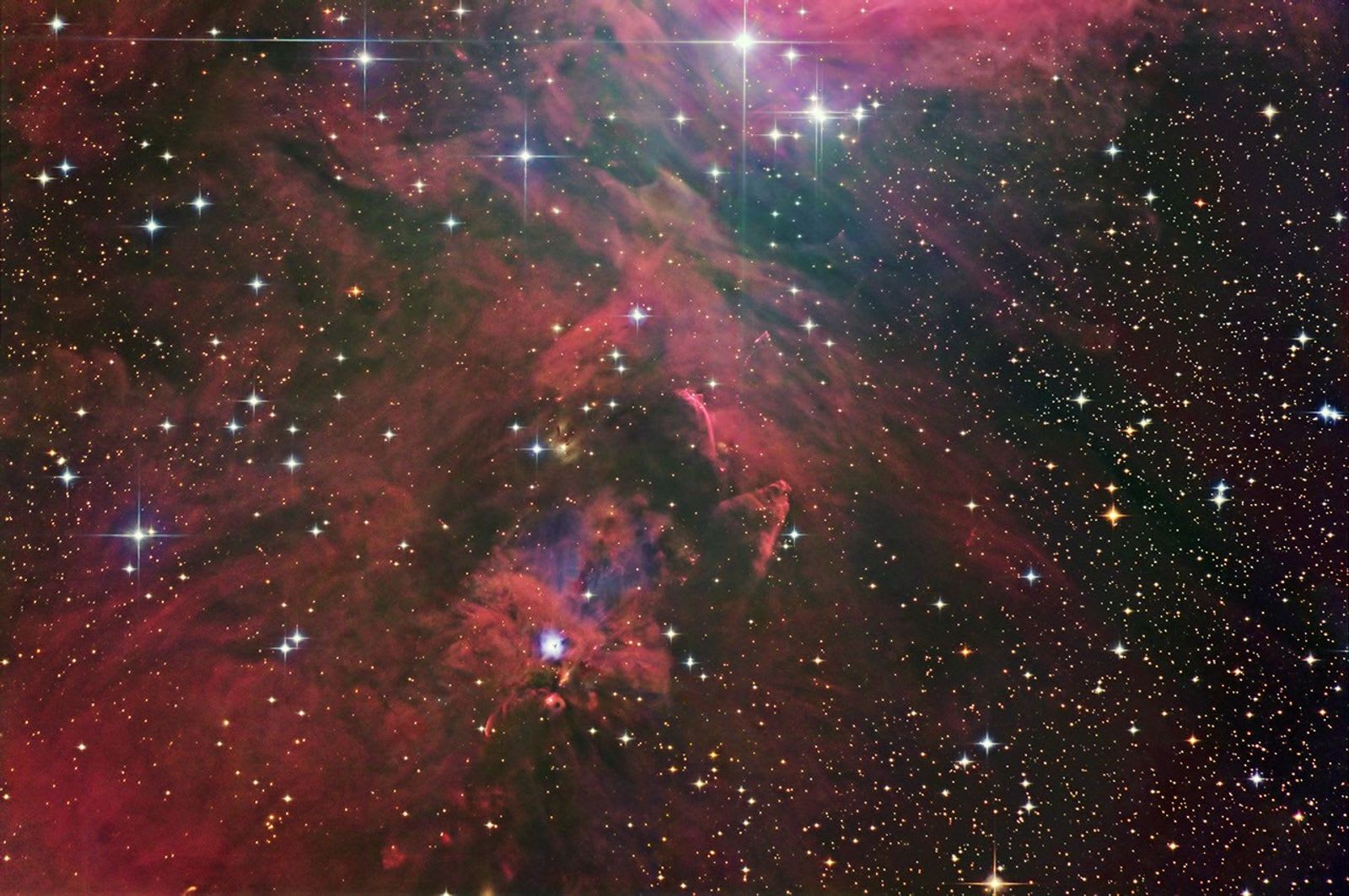
South of Orion
This tantalizing array of nebulae and stars can be found about 2 degrees south of the famous star-forming Orion Nebula. The region abounds with energetic young stars producing jets and outflows that push through the surrounding material at speeds of hundreds of kilometers per second . The interaction creates luminous shock waves known as Herbig-Haro (HH) objects. For example, the graceful, flowing arc just right of center is cataloged as HH 222, also called the Waterfall Nebula. Seen below the Waterfall, HH 401 has a distinctive cone shape. The bright bluish nebula below and left of center is NGC 1999 , a dusty cloud reflecting light from an embedded variable star. The entire cosmic vista spans over 30 light-years, near the edge of the Orion molecular cloud complex some 1,500 light-years distant.