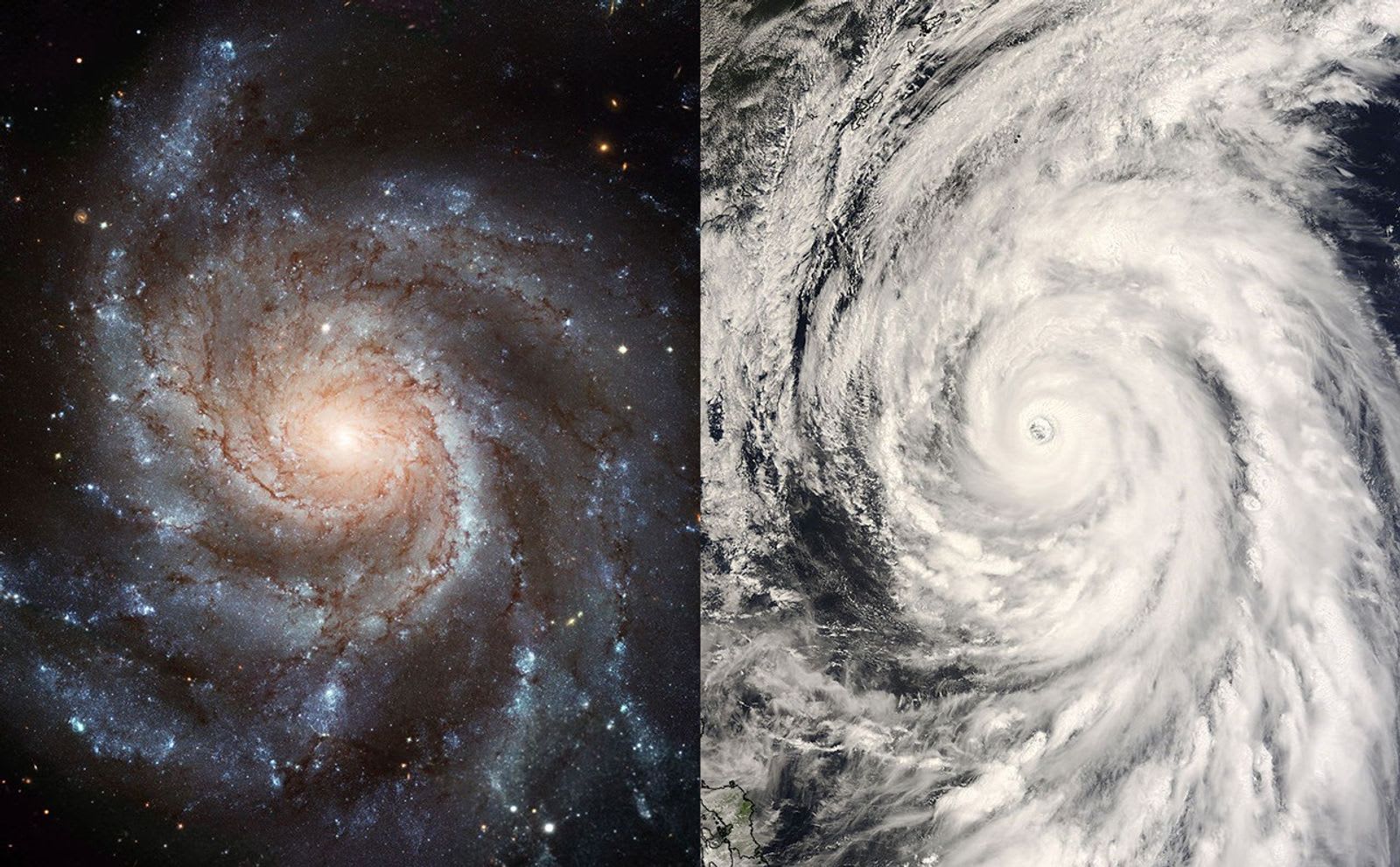
Logarithmic Spirals
Uncomfortably close Typhoon Rammasun (right) and 25 million light-year distant galaxy M101 don't seem to have much in common. For starters, Rammasun was only a thousand kilometers or so across while M101 (aka the Pinwheel Galaxy) spans about 170,000 light-years, making them vastly dissimilar in scale, not to mention the different physical environments that control their formation and development . But they do look amazingly alike: each with arms exhibiting the shape of a simple and beautiful mathematical curve known as a logarithmic spiral , a spiral whose separation grows in a geometric way with increasing distance from the center. Also known as the equiangular spiral , growth spiral, and Bernoulli's spiral or spira mirabilis , this curve's rich properties have fascinated mathematicians since its discovery by 17th century philosopher Descartes . Intriguingly, this abstract shape is much more abundant in nature than suggested by the striking visual comparison above. For example, logarithmic spirals can also describe the tracks of subatomic particles in a bubble chamber , the arrangement of sunflower seeds and, of course, cauliflower .