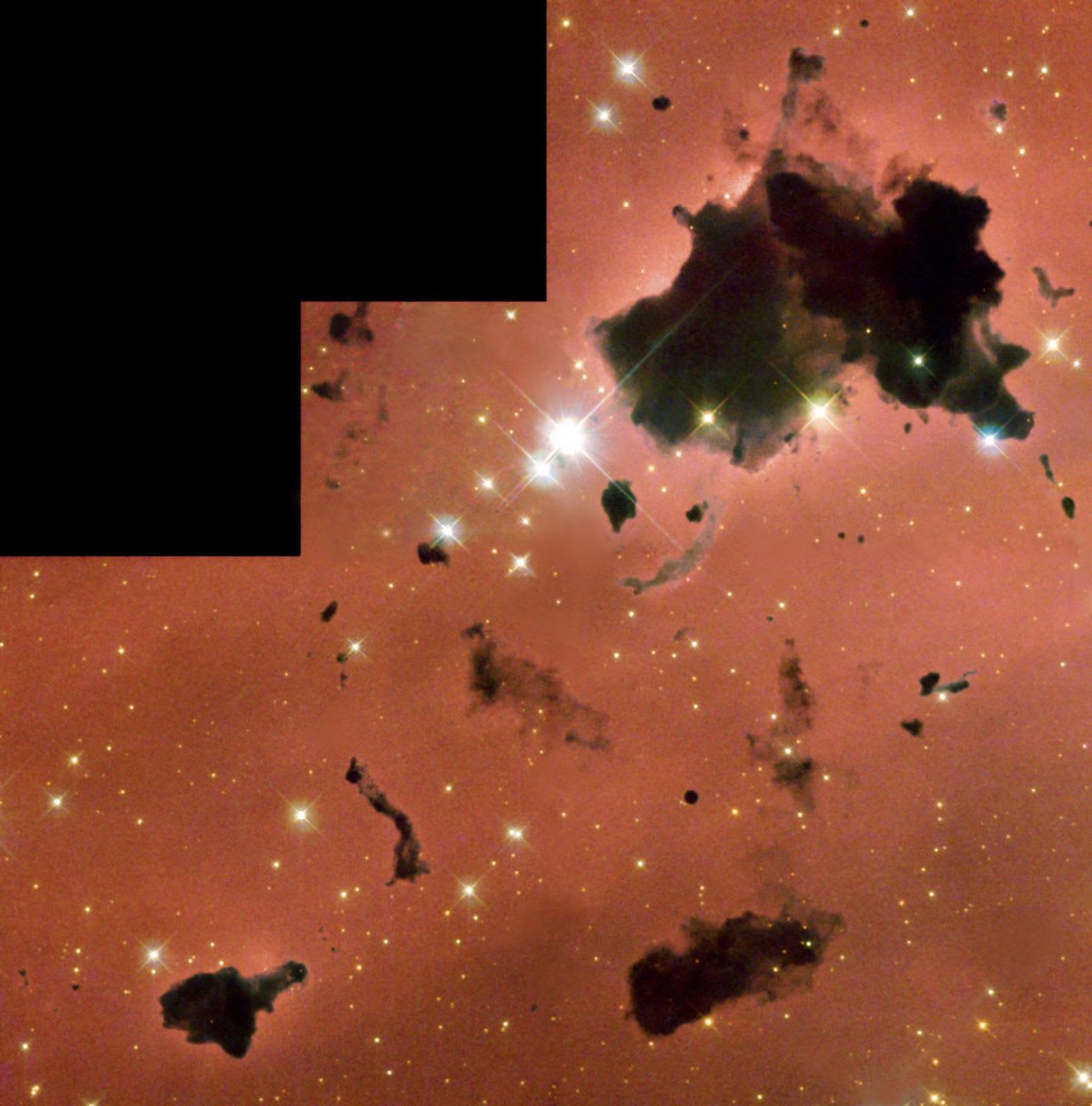
Thackeray's Globules
Rich star fields and glowing hydrogen gas silhouette dense, opaque clouds of interstellar gas and dust in this Hubble Space Telescope close-up of IC 2944 , a bright star forming region in Centaurus , 5,900 light-years away. The largest of these dark globules , first spotted by South African astronomer A. D. Thackeray in 1950, is likely two separate but overlapping clouds, each more than one light-year wide. Combined the clouds contain material equivalent to about 15 times the mass of the Sun , but will they actually collapse to form massive stars? Along with other data, the sharp Hubble images indicate that Thackeray's globules are fractured and churning as a result of intense ultraviolet radiation from young, hot stars already energizing and heating the bright emission nebula . These and similar dark globules known to be associated with other star forming regions may ultimately be dissipated by their hostile environment -- like cosmic lumps of butter in a hot frying pan . Note : APOD Editor to Speak in New York on Jan. 2 digg_url = 'http://apod.nasa.gov/apod/ap081228.html'; digg_skin = 'compact';