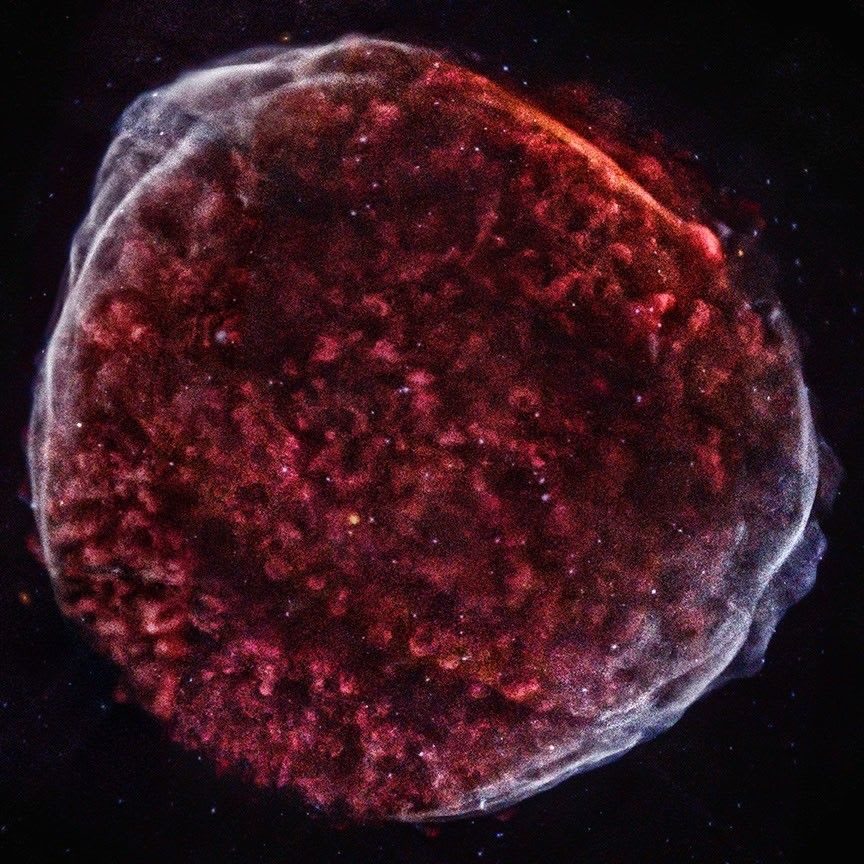
X-rays from Supernova Remnant SN 1006
What looks like a puff-ball is surely the remains of the brightest supernova in recorded human history. In 1006 AD , it was recorded as lighting up the nighttime skies above areas now known as China , Egypt , Iraq , Italy , Japan , and Switzerland . The expanding debris cloud from the stellar explosion, found in the southerly constellation the Wolf ( Lupus ), still puts on a cosmic light show across the electromagnetic spectrum. In fact, the above image results from three colors of X-rays taken by the orbiting Chandra X-ray Observatory . Now known as the SN 1006 supernova remnant , the debris cloud appears to be about 60 light-years across and is understood to represent the remains of a white dwarf star. Part of a binary star system , the compact white dwarf gradually captured material from its companion star. The buildup in mass finally triggered a thermonuclear explosion that destroyed the dwarf star. Because the distance to the supernova remnant is about 7,000 light-years , that explosion actually happened 7,000 years before the light reached Earth in 1006. Shockwaves in the remnant accelerate particles to extreme energies and are thought to be a source of the mysterious cosmic rays . Follow APOD on: Facebook ( Daily ) ( Sky ) ( Spanish ) or Google Plus ( Daily ) ( River )