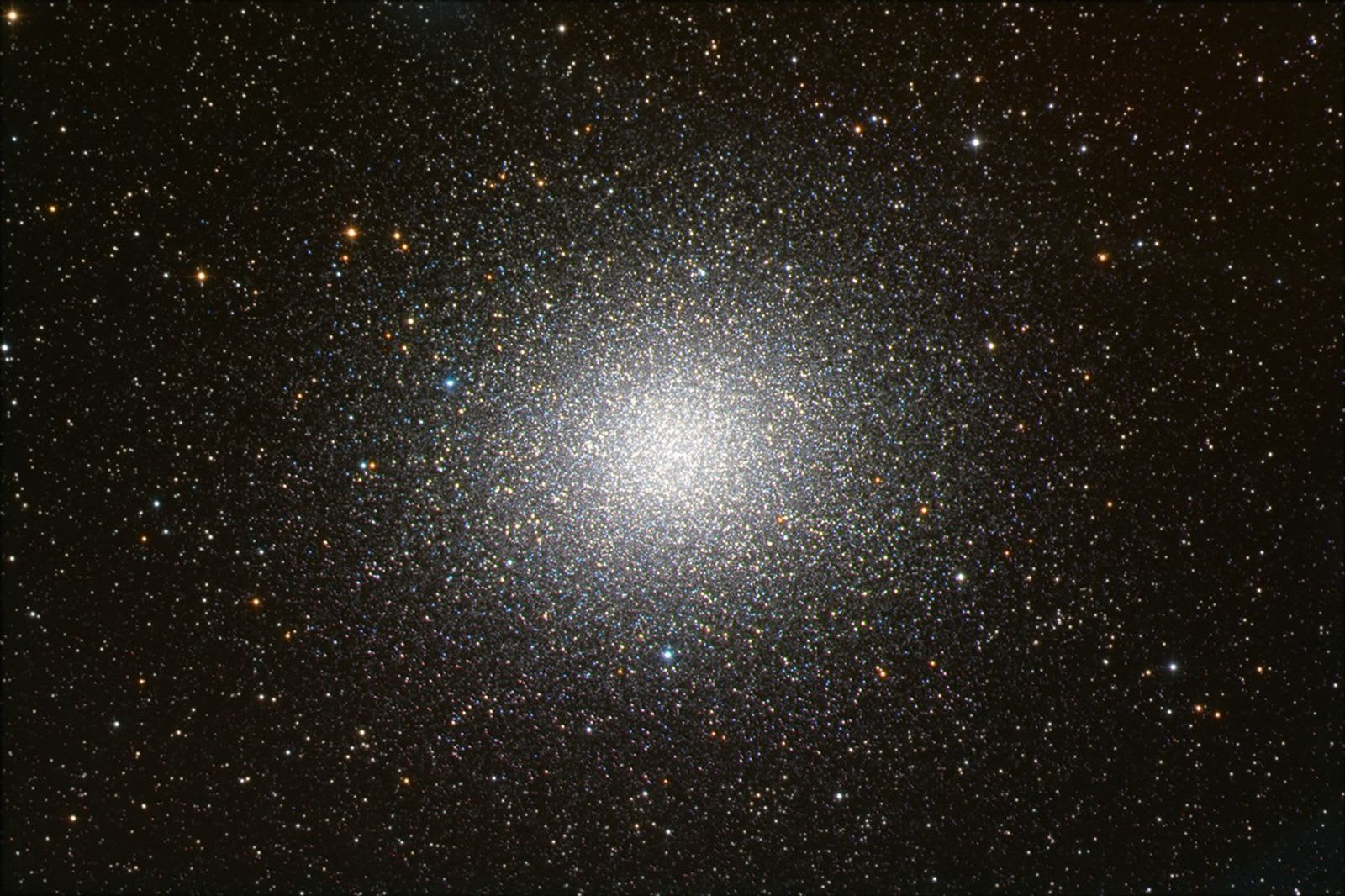
Omega Centauri: The Brightest Globular Cluster
This huge ball of stars predates our Sun. Long before humankind evolved, before dinosaurs roamed , and even before our Earth existed, ancient globs of stars condensed and orbited a young Milky Way Galaxy . Of the 200 or so globular clusters that survive today, Omega Centauri is the largest, containing over ten million stars. Omega Centauri is also the brightest globular cluster , at apparent visual magnitude 3.9 it is visible to southern observers with the unaided eye. Cataloged as NGC 5139, Omega Centauri is about 18,000 light-years away and 150 light-years in diameter. Unlike many other globular clusters , the stars in Omega Centauri show several different ages and trace chemical abundances, indicating that the globular star cluster has a complex history over its 12 billion year age.