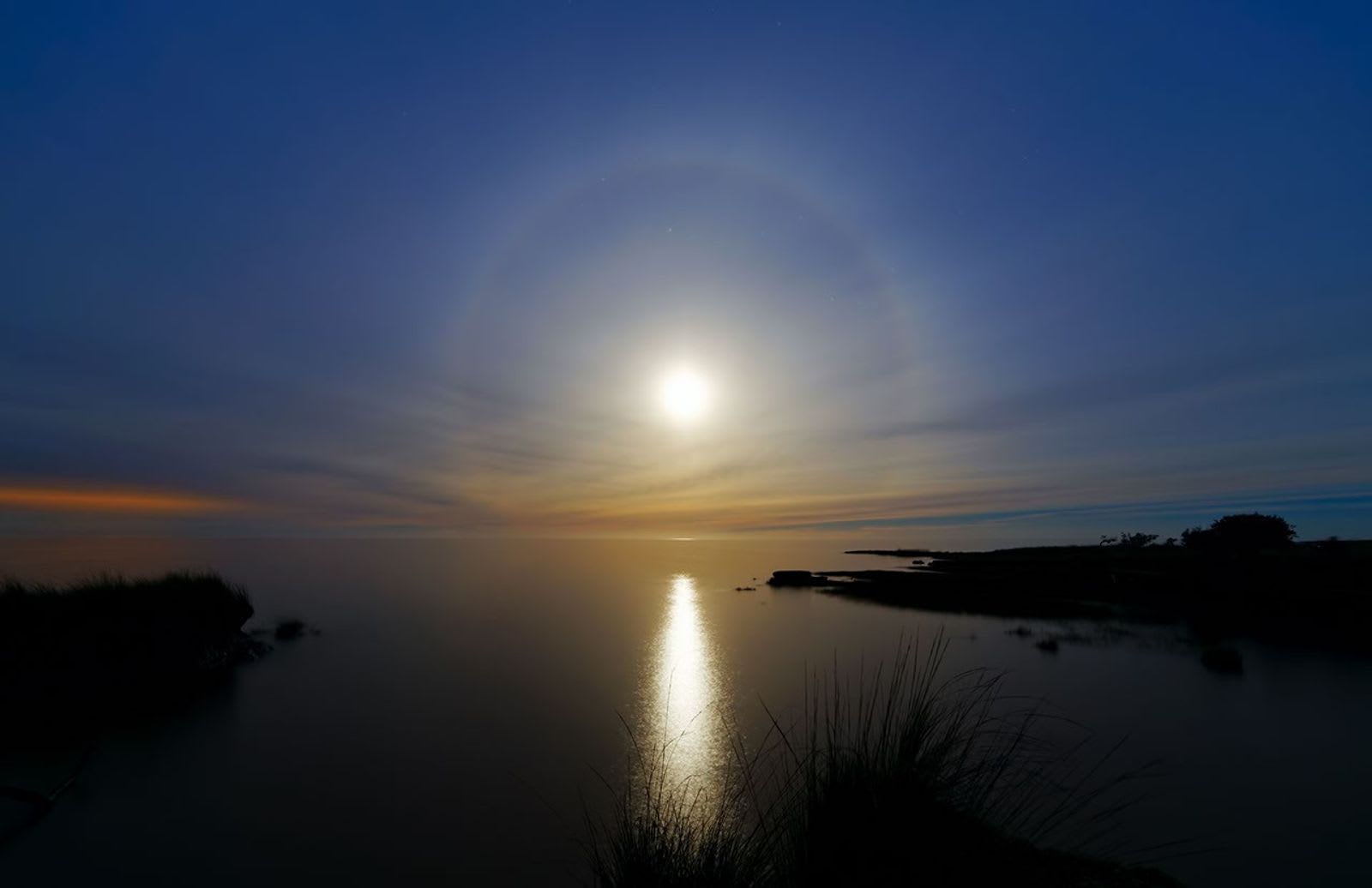
A Super Moon's Halo
A Full Perigee Moon rose as the Sun set last Sunday. At its closest to Earth it was, by just a bit, the year's brightest and largest Full Moon also known as a Super Moon . Seen from Punta Piedras, Argentina and the mouth of the Rio de La Plata, near Buenos Aires, the Super Moon's light created this magnificent circular lunar halo . Still, the size of a lunar halo is determined by the geometry of six sided water ice crystals in planet Earth's high, thin clouds. The crystals deflect the rays of moonlight more strongly through a minimum angle of 22 degrees. So this halo has an inner radius of 22 degrees, just like the halos of the less-than-super moons. Even more common than a Super Moon, beautiful 22 degree halos can be spotted at any time of year.