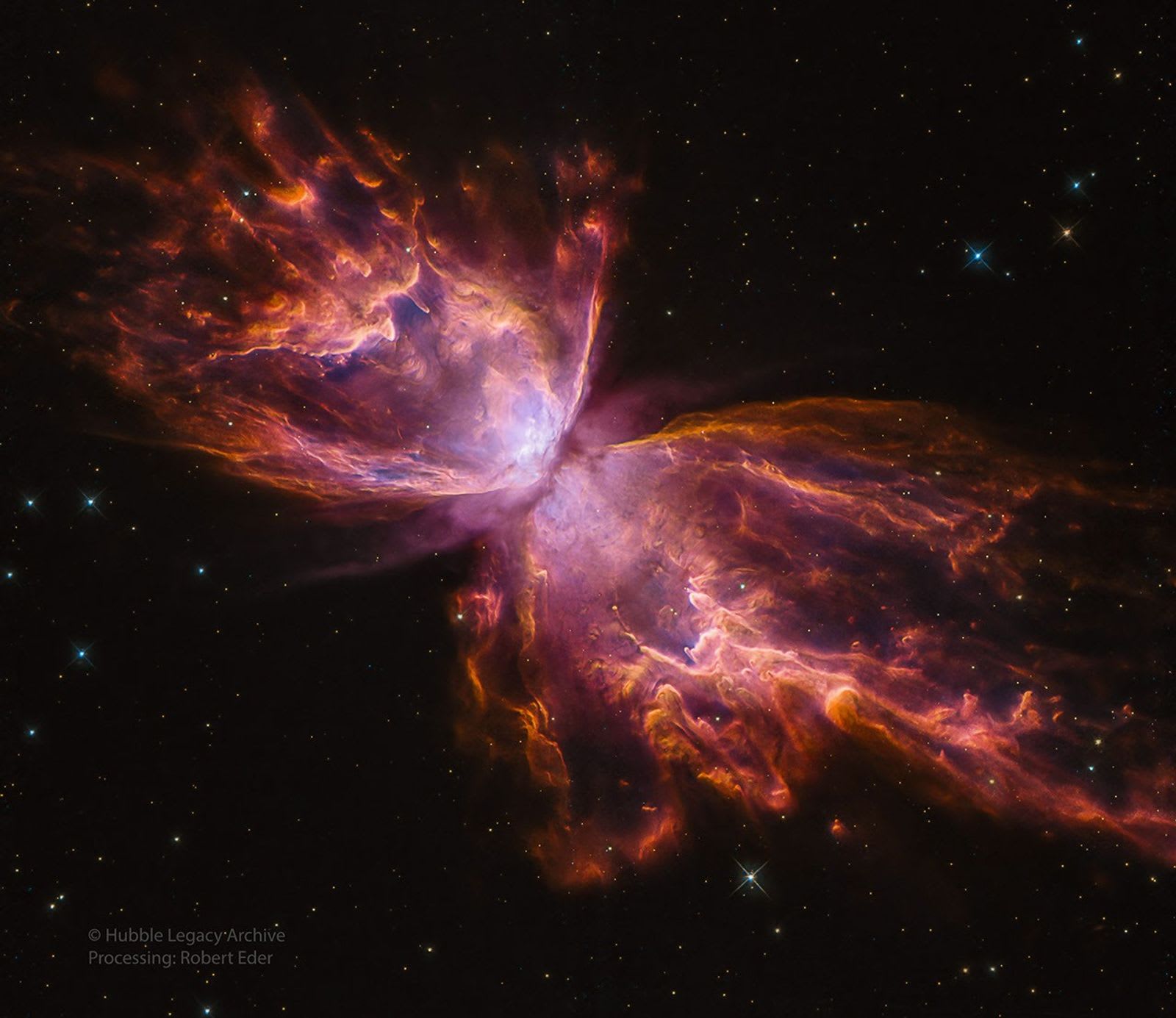
NGC 6302: The Butterfly Nebula
The bright clusters and nebulae of planet Earth's night sky are often named for flowers or insects . Though its wingspan covers over 3 light-years, NGC 6302 is no exception. With an estimated surface temperature of about 250,000 degrees C , the dying central star of this particular planetary nebula has become exceptionally hot, shining brightly in ultraviolet light but hidden from direct view by a dense torus of dust. This sharp close-up was recorded by the Hubble Space Telescope in 2009. The Hubble image data is reprocessed here, showing off the remarkable details of the complex planetary nebula. Cutting across a bright cavity of ionized gas, the dust torus surrounding the central star is near the center of this view, almost edge-on to the line-of-sight. Molecular hydrogen has been detected in the hot star's dusty cosmic shroud. NGC 6302 lies about 4,000 light-years away in the arachnologically correct constellation of the Scorpion ( Scorpius ).