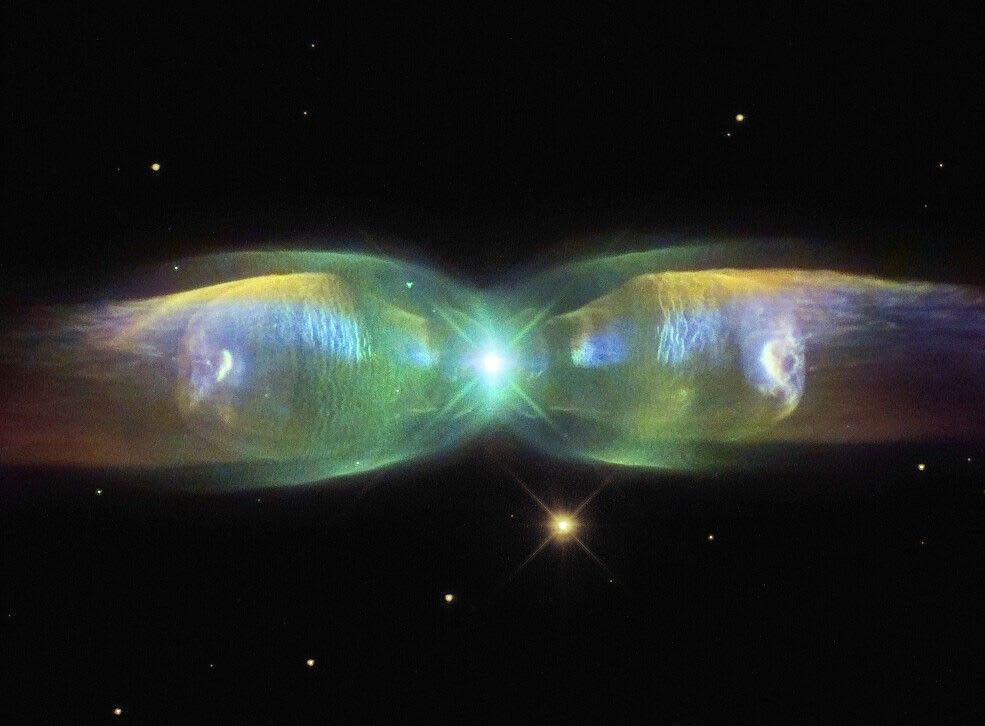
M2-9: Wings of a Butterfly Nebula
Are stars better appreciated for their art after they die? Actually, stars usually create their most artistic displays as they die. In the case of low-mass stars like our Sun and M2-9 pictured here , the stars transform themselves from normal stars to white dwarfs by casting off their outer gaseous envelopes. The expended gas frequently forms an impressive display called a planetary nebula that fades gradually over thousands of years. M2-9 , a butterfly planetary nebula 2100 light-years away shown in representative colors, has wings that tell a strange but incomplete tale . In the center, two stars orbit inside a gaseous disk 10 times the orbit of Pluto . The expelled envelope of the dying star breaks out from the disk creating the bipolar appearance . Much remains unknown about the physical processes that cause and shape planetary nebulae . Almost Hyperspace: Random APOD Generator