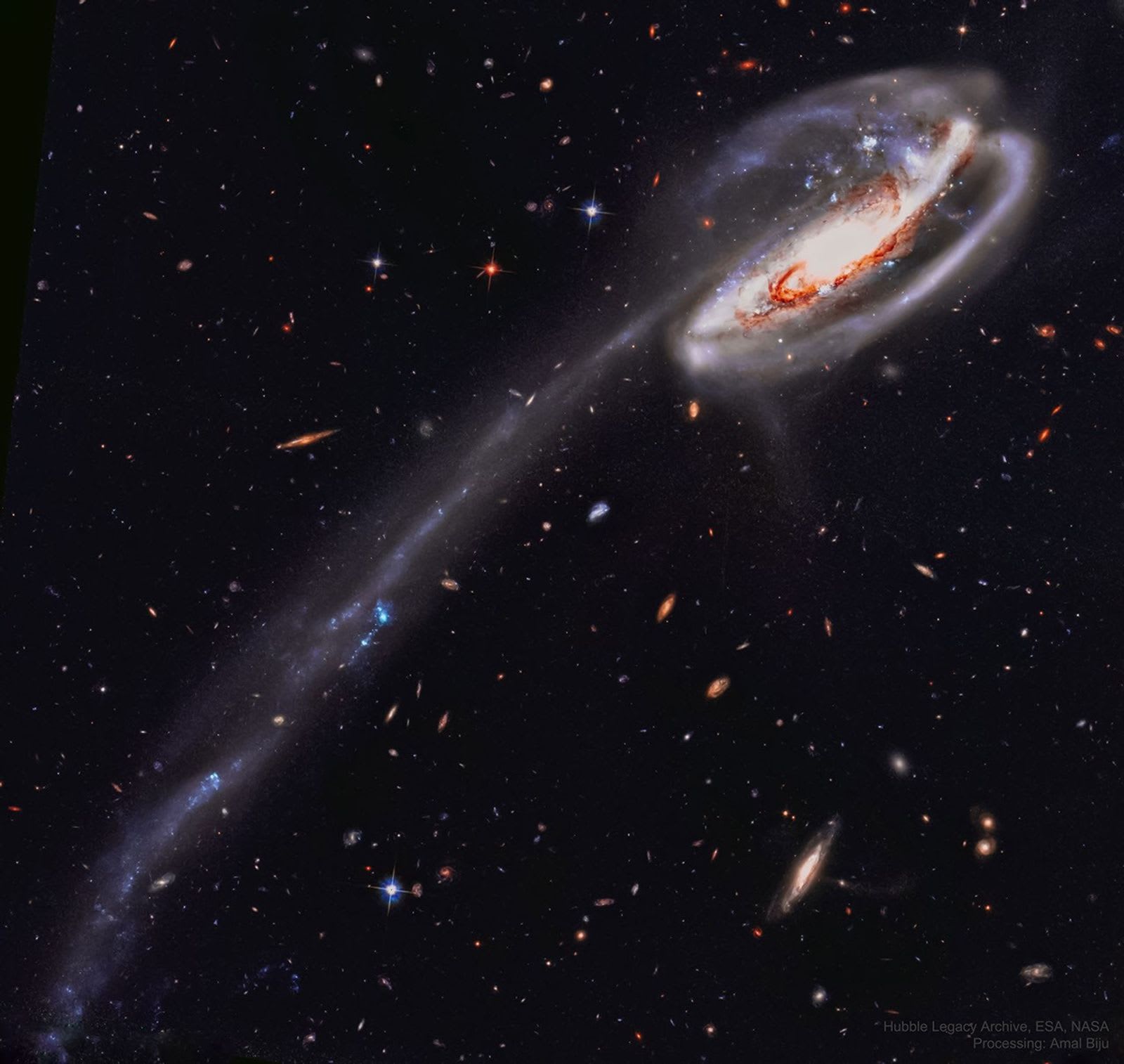
The Tadpole Galaxy from Hubble
Why does this galaxy have such a long tail? In this stunning vista , based on image data from the Hubble Legacy Archive , distant galaxies form a dramatic backdrop for disrupted spiral galaxy Arp 188, the Tadpole Galaxy. The cosmic tadpole is a mere 420 million light-years distant toward the northern constellation of the Dragon ( Draco ). Its eye-catching tail is about 280 thousand light-years long and features massive, bright blue star clusters. One story goes that a more compact intruder galaxy crossed in front of Arp 188 - from right to left in this view - and was slung around behind the Tadpole by their gravitational attraction. During the close encounter , tidal forces drew out the spiral galaxy's stars, gas, and dust forming the spectacular tail. The intruder galaxy itself, estimated to lie about 300 thousand light-years behind the Tadpole, can be seen through foreground spiral arms at the upper right. Following its terrestrial namesake , the Tadpole Galaxy will likely lose its tail as it grows older, the tail's star clusters forming smaller satellites of the large spiral galaxy. APOD in world languages: Arabic , Bulgarian , Catalan , Chinese (Beijing), Chinese (Taiwan), Croatian , Czech , Dutch , Farsi , French , German , Hebrew , Indonesian , Japanese , Korean , Montenegrin , Polish , Russian , Serbian , Slovenian , Spanish , Taiwanese , Turkish , Turkish , and Ukrainian