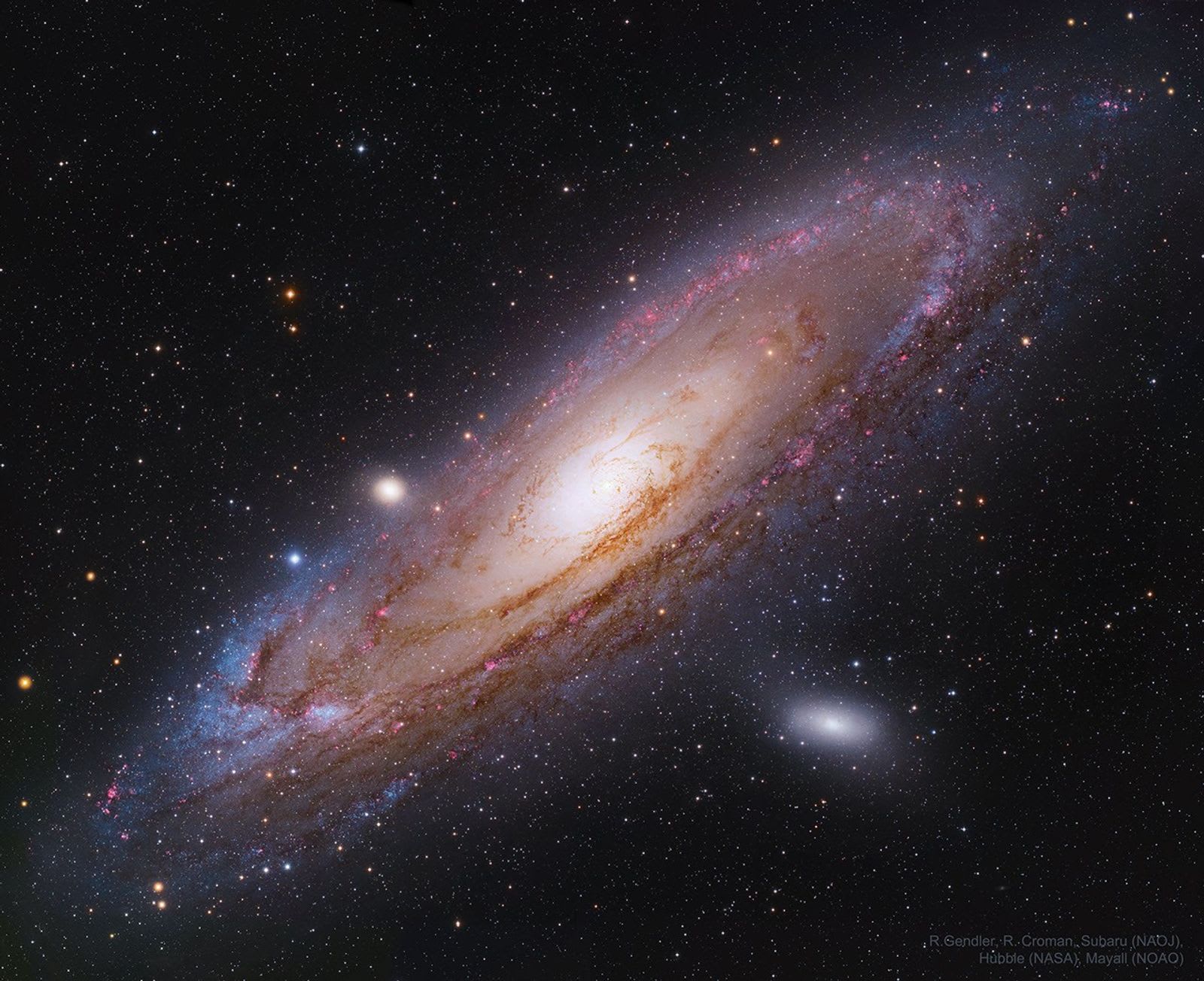
M31: The Andromeda Galaxy
Credit: Subaru (NAOJ), Hubble (NASA / <a ESA), Mayall (NSF); Processing & Copyright: R. Gendler & R. Croman
The most distant object easily visible to the unaided eye is M31, the great Andromeda Galaxy. Even at some two and a half million light-year s distant, this immense spiral galaxy -- spanning over 200,000 light years -- is visible, although as a faint, nebulous cloud in the constellation Andromeda. In contrast, a bright yellow nucleus, dark winding dust lanes, and expansive spiral arms dotted with blue star cluster s and red nebulae, are recorded in this stunning telescopic image which combines data from orbiting Hubble with ground-based images from Subaru and Mayall. In only about 5 billion years, the Andromeda galaxy may be even easier to see -- as it will likely span the entire night sky -- just before it merges with our Milky Way Galaxy.