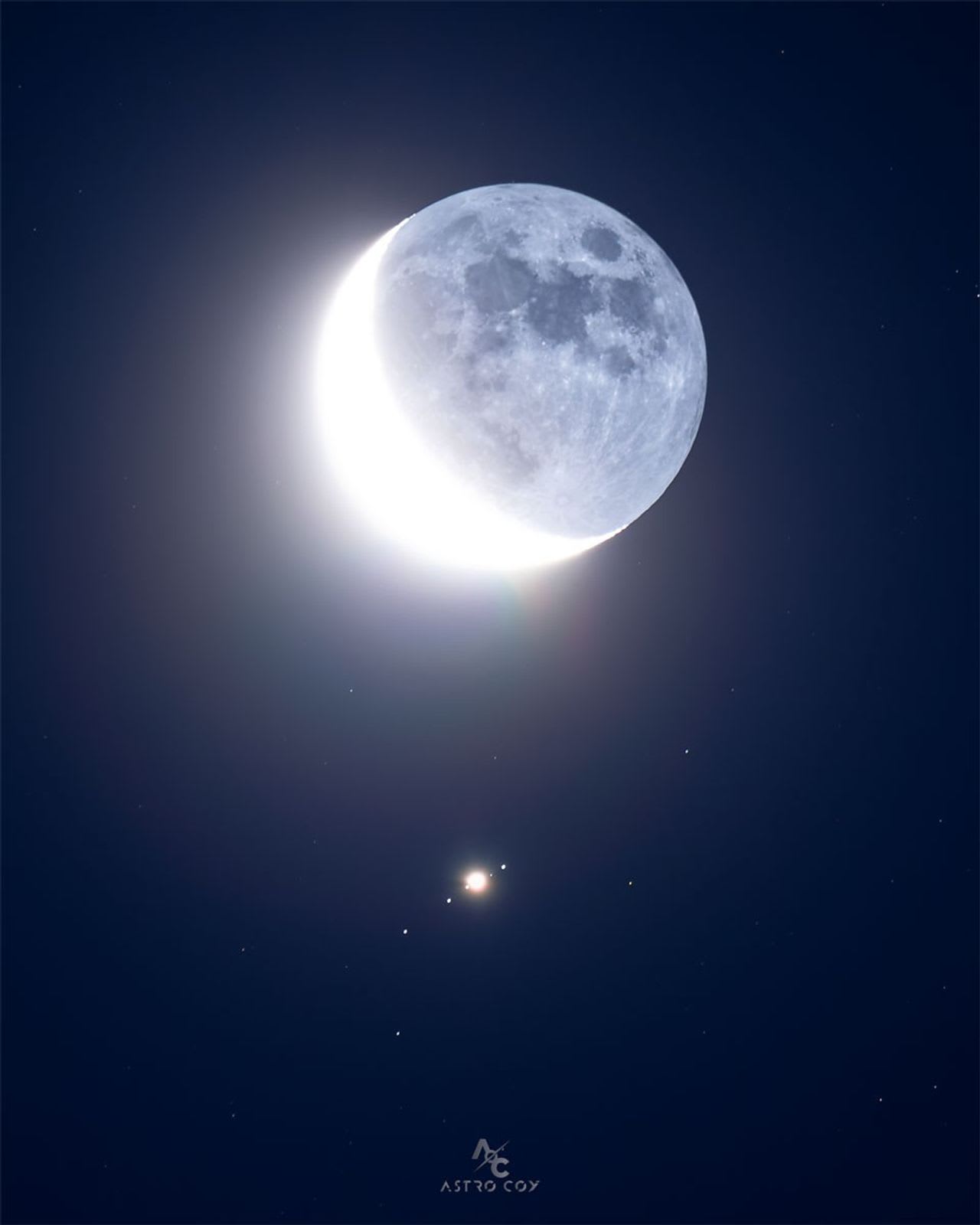
Moon Meets Jupiter
Credit: Jordi L. Coy
What's that below the Moon? Jupiter -- and its largest moons. Many skygazers across planet Earth enjoyed the close conjunction of Earth's Moon passing nearly in front of Jupiter in mid-June. The featured image is a single exposure of the event taken from Morón de la Frontera, Spain. The sunlit lunar crescent on the left is overexposed, while the Moon's night side, on the right, is only faintly illuminated by Earthshine. Lined up diagonally below the Moon, left to right, are Jupiter's bright Galilean satellites: Callisto, Ganymede, Io (hard to see as it is very near to Jupiter), and Europa. In fact, Callisto, Ganymede, and Io are larger than Earth's Moon, while Europa is only slightly smaller. NASA's robotic spacecraft Juno is currently orbiting Jupiter and made a close pass near Io only a week ago. If you look up in the night sky tonight, you will again see two of the brightest objects angularly close together -- because tonight is another Moon-Jupiter conjunction.