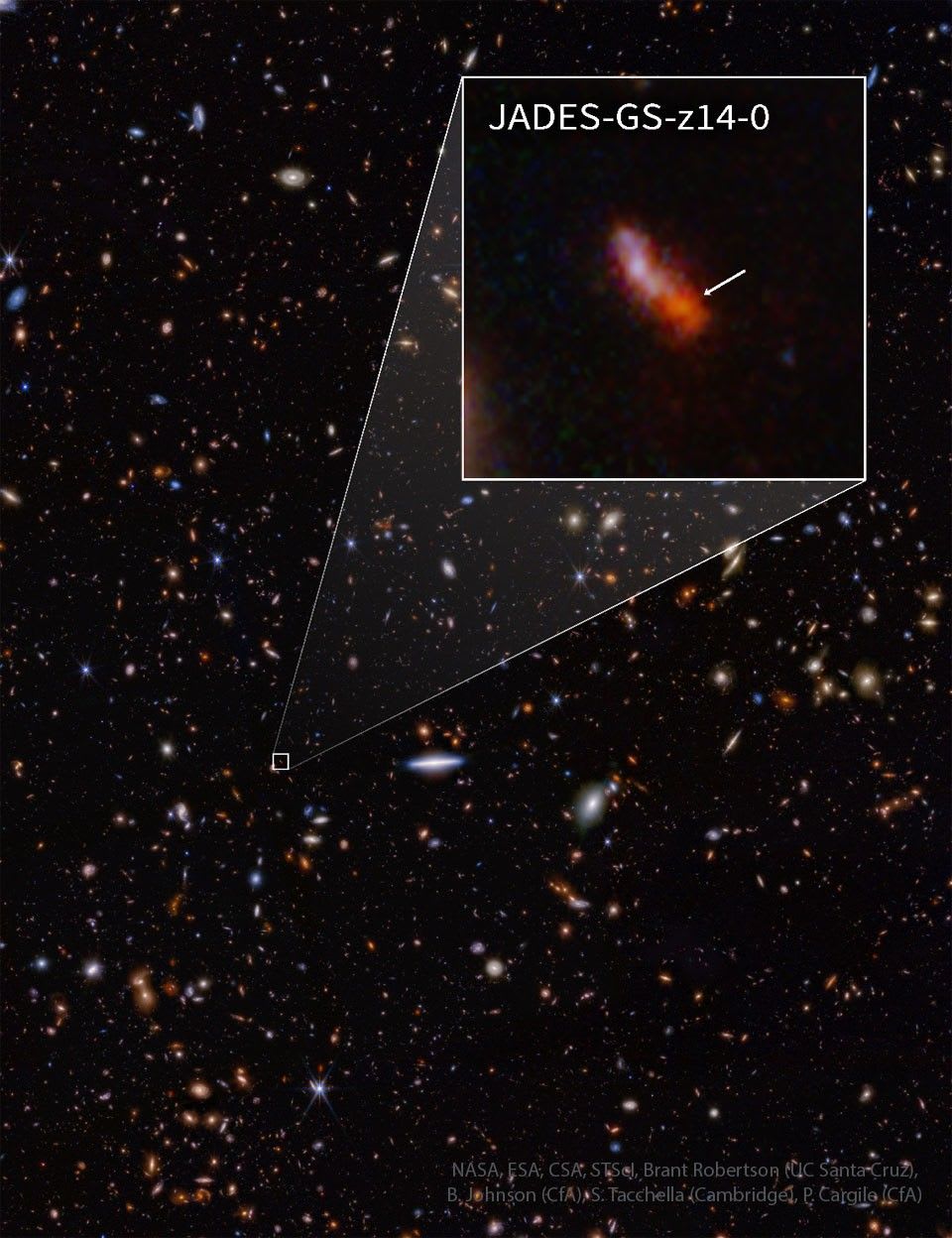
JADES-GS-z14-0: A New Farthest Object
Credit: NASA, ESA, CSA, STScI, B. Robertson (UC Santa Cruz), B. Johnson (CfA), S. Tacchella (Cambridge), P. Cargile (CfA)
What if we could see back to the beginning of the universe? We could see galaxies forming. But what did galaxies look like back then? These questions took a step forward recently with the release of the analysis of a James Webb Space Telescope (JWST) image that included the most distant object yet discovered. Most galaxies formed at about 3 billion years after the Big Bang, but some formed earlier. Pictured in the inset box is JADES - GS-z14-0, a faint smudge of a galaxy that formed only 300 million years after the universe started. In technical terms, this galaxy lies at the record redshift of z=14.32, and so existed when the universe was only one fiftieth of the its present age. Practically all of the objects in the featured photograph are galaxies.