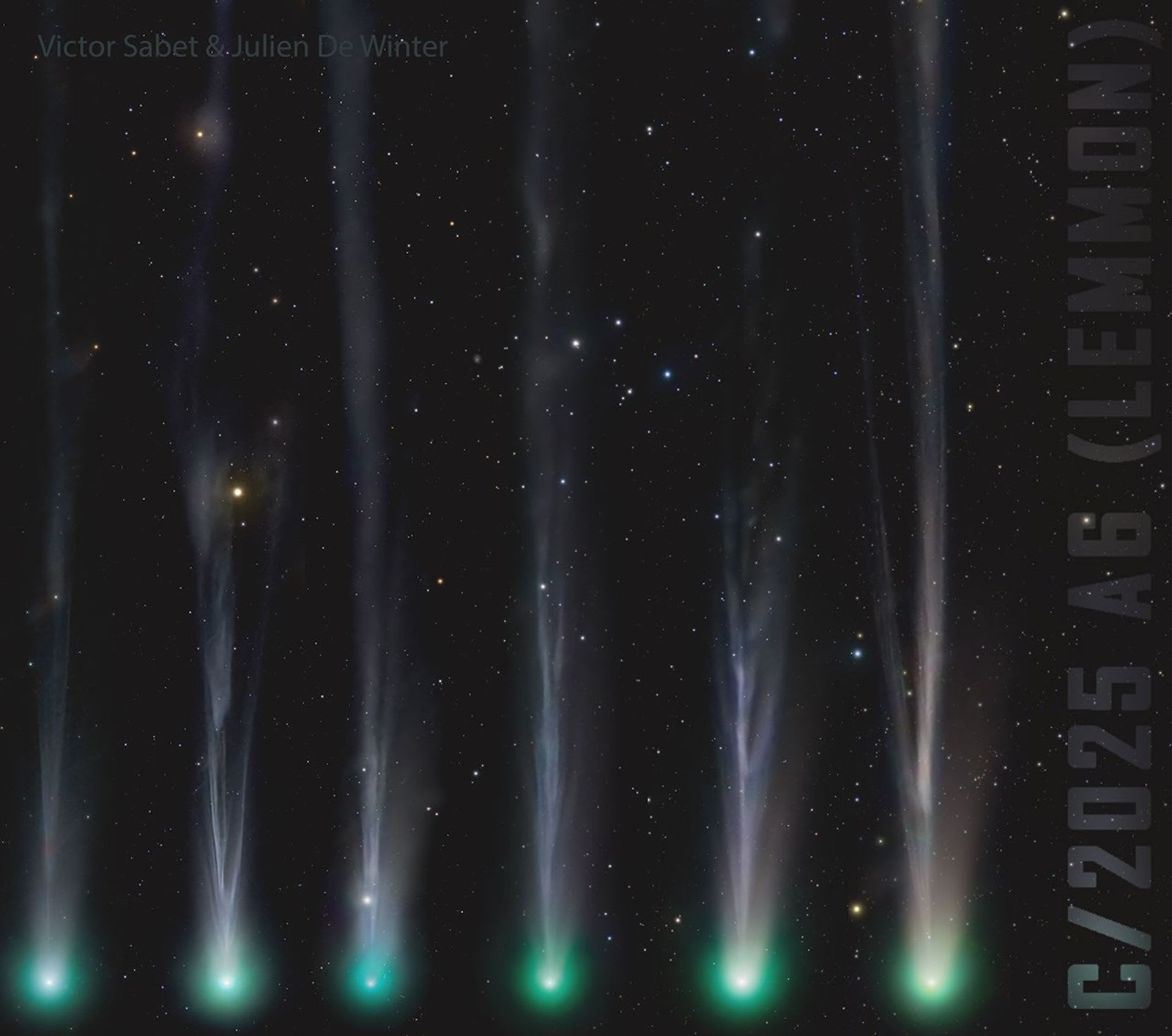
The Changing Ion Tail of Comet Lemmon
Credit: Victor Sabet & Julien De Winter
How does a comet tail change? It depends on the comet. The ion tail of Comet C/2025 A6 (Lemmon) has been changing markedly, as detailed in the featured image sequenced over six days between September 25 and October 4 (left to right) from Texas, USA. On some days, the comet's ion tail was relatively more complex than other days. Reasons for tail changes include the rate of ejection of material from the comet's nucleus, the strength and complexity of the passing solar wind, and the rotation rate of the comet. Sometimes, over the course of a week, apparent differences even result from a change of perspective from the Earth. In general, a comet's ion tail will point away from the Sun, as gas expelled is pushed out by the Sun's wind. Comet Lemmon is still inbound and brightening, passing nearest the Earth on October 21 and nearest the Su n on November 8.