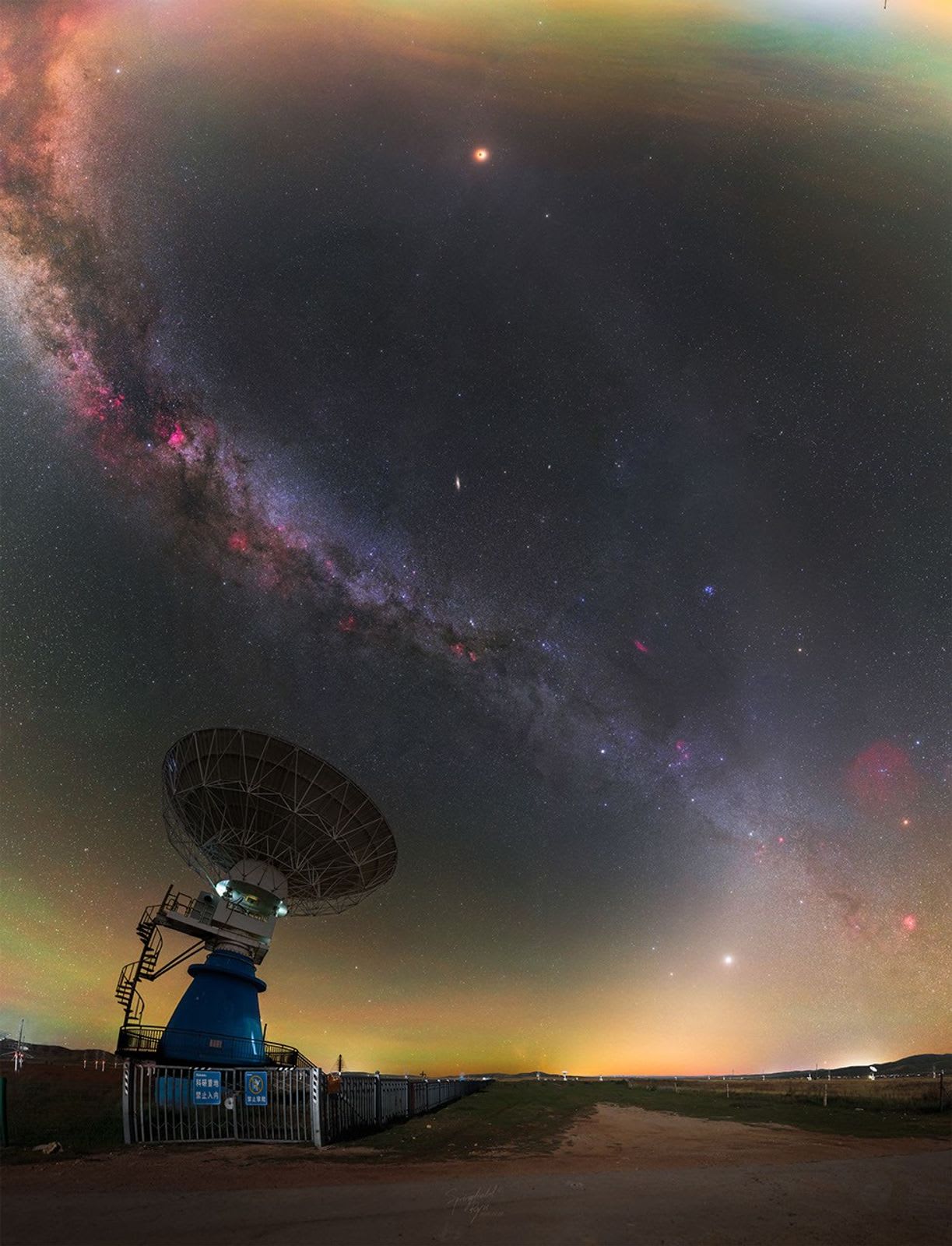
A Double Helix Lunar Eclipse
The image was timed to capture a total lunar eclipse -- but it came with quite a twist. First, the eclipse : the fully Earth-shadowed Moon is visible as the orange orb near the top. The eclipsed Moon 's orange color is caused by a slight amount of red light scattered first by Earth's atmosphere , adding a color like a setting Sun . Now, the twist: one of the apparent double helix bands is the Milky Way , the central disk of our home galaxy. The second band is zodiacal light , sunlight scattered by dust in our Solar System . The reason they cross is because the plane where dust orbits our Sun is tilted relative to the plane where stars orbit our Galaxy. This well-known tilt is shown dramatically in the featured wide-angle Mercator-projected picture, spanning from horizon to horizon , captured in early September from Mingantu Observing Station in Inner Mongolia , China .